Dyslexia
As I regularly get asked about it, I thought it would be good to pull together some details and links that I have found interesting and/or useful.
Throughout my education, I have always had difficulties reading, but it was always disputed that I had any form of dyslexia. I was eventually assessed as dyslexic at age 45; this was a full psychological assessment from The Dyslexia Institute. On the Turner Index, a scale from A to F where A indicates no dyslexia and F indicates severe dyslexia, I was assessed at level C, described as mild dyslexia. I have sought to find ways to make reading easier. This has led me to look into ‘Visual Stress’ and how this can be assessed and managed.
I first went for a Visual Stress Assessment at Glasgow Caledonian University. This resulted in me being prescribed reddish-orange lenses. 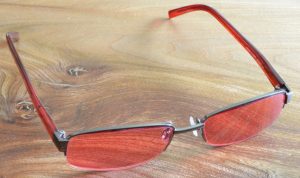 These helped sometimes but made things worse at other times. The lenses were manufactured by Cerium Visual Technologies, which I discovered has a fair amount of information about Visual Stress on its website. I then heard about the work of Ian Jordan, an optician in Ayr specialising in various conditions, including dyslexia.
After an eye test and assessment at Jordan’s, I was prescribed blue lenses and have found them much more successful than the reddish-orange ones.  There are some interesting YouTube videos giving much more information. The video quality is poor, but it’s worth putting up with for the content. As a footnote, it’s also worth saying I suffer from far fewer migraine headaches nowadays since using the blue lenses.
However, although the headaches have reduced significantly, they haven’t ceased, and I was still getting fairly regular headaches, which seemed to be vision-related. On my return visit to Jordan’s for a routine check after having had the blue glasses for two years, Ian Jordan thought something still wasn’t right if I was still getting regular vision-related headaches. So, after further tests, he independently tested my eyes for colour and found they were indeed different. My latest glasses are asymmetrical, one lens being blue and the other yellow. I’ve been getting asked about the latest frames, which are by Ronit Furst.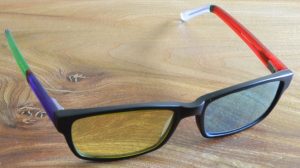
People ask, what does this do? Well, it somehow reduces the visual stress by neutralising some unwanted 3D effects. It’s a little like 3D glasses in reverse for the cinema, and it’s called the Pulfrich effect. Having now been wearing these for several months, I very rarely use normal clear glasses, as I much prefer them, which have been a surprisingly significant improvement over my previous blue glasses. Although not completely gone, the migraine headaches have now become the exception, rather than the norm.